


NIH Awards Jax Bari and Celiac Journey as One of the Top Scientific Teams for Innovations Linking Nutrition and Autoimmune Disease


On March 30, 2026, the National Institutes of Health (NIH) awarded Jax Bari (age 13) and Celiac Journey as one of the top scientific teams for innovations linking nutrition and autoimmune disease in the NIH's Nutrition for OUR Immune System Health (NOURISH) Autoimmunity Challenge. According to the NIH, Jax's winning entry "showed thoughtful planning and designs that, with further development, could result in innovative solutions to benefit Americans affected by autoimmune diseases." In total, there were 15 prize awards of $10,000 to each team. Jax was the youngest winner selected by the NIH's panel of judges in the NOURISH Autoimmunity Challenge.
Watch Jax's Acceptance & Award Announcement
"Thank you [Jax] for all the proposals and thank you for all of your brilliant ideas." -- Victoria Shanmugam, MD, Director, Office of Autoimmune Disease Research, National Institutes of Health
Watch the Entire Winners' Presentation Webinar, March 30, 2026
According to Dr. Jay Bhattacharya, M.D., Director of the National Institutes of Health and the
"Autoimmune diseases influence every system in the body and pose significant risks to human health throughout the lifespan. Between 23.5 and 50.0 million people in America live with one or more autoimmune diseases; collectively, autoimmune diseases represent some of the most common chronic diseases affecting the U.S. population. Beyond their own substantial morbidity and mortality, autoimmune diseases commonly co-occur with other debilitating chronic conditions. These findings reinforce the observation that autoimmune diseases touch the lives of every person in America."
NOURISH Autoimmunity Challenge
The NOURISH Autoimmunity Challenge competition sought bold ideas to better understand how dietary interventions could influence disease onset and symptom management. Several concepts focused on mechanistic and biomarker-driven approaches that link diet, the gut microbiome, and immune system activity. These projects recommend leveraging proteomics, microbiome analysis, and other multi-omics technologies to better understand biological pathways through which nutrition may influence autoimmune disease onset, progression, and flares.
Jax's Winning Research Idea: Celiac Flare Data & Drug Repurposing
Jax's concept focused on mechanistic and biomarker-driven approaches that link diet, the gut microbiome, and immune system activity. Jax's ideas have been inspired through his meeting with Dr. David Fajgenbaum, David's amazing TED Talk, and his trailblazing work on drug repurposing.
The project's ideation focused on studying serum samples from Celiac Disease patients in an active flare which may unlock novel biological insights, biomarkers and treatment approaches for Celiac and other inflammatory conditions. The concept involves quantifying any difference that may exist in proteomic levels between Celiac patients and healthy controls, and across patients with other inflammatory diseases. To that end, Jax's ideas focus on studying proteomic changes that may point towards candidate mechanisms involved in Celiac that can be measured as a biomarker and/or targeted with a novel treatment.
Flare Data can also provide insights into mechanisms that may be involved in Celiac pathogenesis.
Jax's project recommended leveraging proteomics, microbiome analysis, and other multi-omics technologies to better understand biological pathways through which nutrition may influence autoimmune disease onset, progression, and flares.
Based on Dr. David Fajgenbaum's kind offer to leverage big data, Jax wants to integrate this Celiac flare data into the Serum Proteomic Analysis of Cytokine-driven study (SPACE study for short) at Penn Medicine.
From there, AI can help researchers map new knowledge with existing knowledge to find hidden relationships between genes, proteins, diseases and drugs.
This data may inform larger studies to identify FDA approved drugs that may be suitable candidates for drug repurposing for Celiac Disease.
Jax has been so inspired by Dr. Fajgenbaum and how he chased his own cure through drug repurposing with sirolimus. According to Jax, "I want to find the Celiac community's sirolimus!"
Make Our Children Healthy Again Strategy Report
In September 2025, the White House released the Make Our Children Healthy Again Strategy Report (MAHA Strategy Report). The MAHA Strategy Report included 128 bold initiatives, including three areas that are very important to Celiac Journey's mission:
"Food Allergies: FDA will develop guidance on diagnostics and treatments for food allergies. FDA will also make recommendations about requiring transparency in disclosures of ingredients that impact certain health conditions, such as gluten for those with Celiac disease, and other established food allergens."
"Repurposed Drugs: The NIH and FDA will jointly investigate opportunities to strengthen the use of repurposed drugs for the treatment of chronic disease, while harmonizing authorization processes through collaborative clinical trial designs to achieve FDA approval."
"Gut Microbiome Research Initiative: NIH will continue to fund research to deepen our understanding of the gut microbiome’s critical role in chronic disease development and progression in children to identify novel interventions that could transform preventive and therapeutic approaches."
List of Winners of NOURISH Autoimmunity Challenge
Transcript & Slides from Jax Bari's Winner's Announcement
"Hi. I’m Jax Bari. I’m 12 years old, and I’m the Co-Founder of Celiac Journey.
I’m grateful for this opportunity to share my goal – Eating without fear!
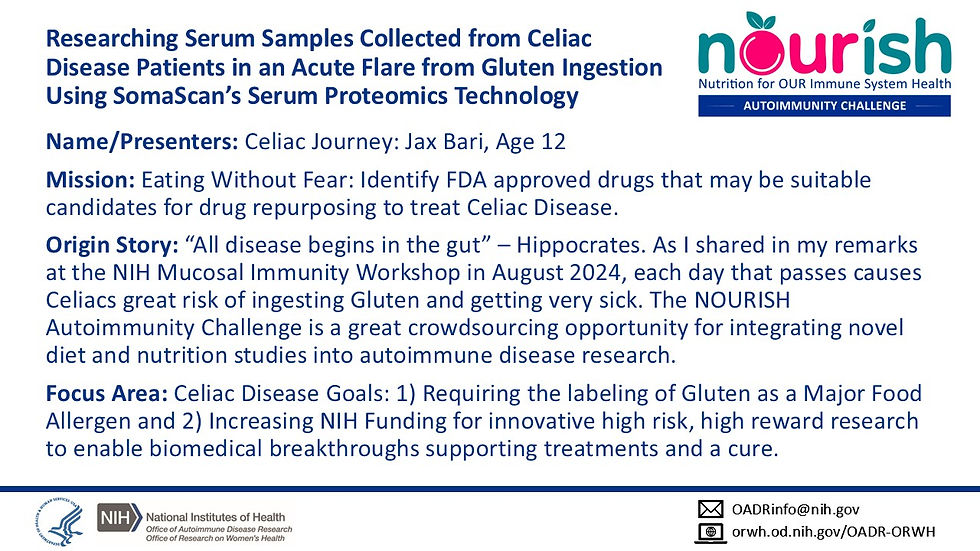
I'm honored to be one the winners in the NIH’s NOURISH CHALLENGE for my idea to study Celiac Disease flare data to identify FDA approved drugs that may be suitable candidates
for drug repurposing to treat Celiac.
I'm grateful to Secretary Kennedy for his whole-of-government approach to tackling childhood chronic disease, including Celiac Disease.
Hippocrates had amazing insight when he said, “All Disease Begins in the Gut!”
The new Dietary Guidelines just flipped the food pyramid with a great call to action to "Eat Real Food!"
Similarly, the FDA is turning the tide on the Gluten guessing game. In January, the FDA issued a Request for Information on Gluten Labeling in response to my Citizen Petition to require the labeling of Barley, Rye and Oats as Major Food Allergens.
And the NIH is now changing the game to champion Celiac research. Thanks Dr. Bhattacharya.
Just before I started Kindergarten, I was diagnosed with Celiac when I was not growing.

Like 729,000 American children, I have Celiac Disease which is a potentially life-threatening food allergy and auto-immune disease.
Celiac impacts more than 3.3 million Americans, greater than 1.0% of the general population.
Despite some advances in diagnosis and management, the only available treatment for Celiac remains a restrictive lifelong Gluten Free diet which is highly burdensome, very costly, and insufficient since many patients continue to experience symptoms and mucosal damage.
Celiac is triggered by eating Gluten, a protein found in Wheat, Barley, Rye and most Oats.
Since 2006, Wheat has been required to be labeled in the U.S., but Barley, Rye and Oats have not! That’s created a massive food safety gap!
44% of Celiacs who follow a strict Gluten Free diet still get Glutened once per month.
Gluten ingestion for Celiacs causes more than 200 debilitating symptoms including anemia, cancer, intestinal damage, and malnutrition.
Gluten is like kryptonite to me.
If I eat just a crumb of Gluten, just a crumb, I can get very sick, living on the bathroom floor, with vomiting and diarrhea for days. It’s awful!
Gluten also damages my small intestine.
When I was 5, I had Marsh 3 level damage to my small intestine from Gluten.
I was told that the doctors only see Marsh 4 level damage when they do an autopsy. It was really bad!

Celiac is every bite, every day!
Constant worrying, constant questioning, constant uncertainty.
Celiac is a Disease, NOT a Diet!
Unlike IgE-Mediated food allergies, there’s no rescue medication for Celiacs in the event of accidental ingestion of Gluten, and one cannot outgrow Celiac.
We're fed up and it's time for change.
Last August, I met with the White House Domestic Policy Council, and the MAHA Commission included my common sense solution on labeling Gluten in the Make Our Children Healthy Again Strategy Report!
The MAHA Strategy Report also includes two of our research interest areas: the gut microbiome and drug repurposing.

I was so excited to apply to the NIH's NOURISH Challenge that I submitted three ideas:
researching Molecular Changes Between Present Day Tissue Samples of Celiac Patients as Compared with Their Umbilical Cord Blood Tissue Samples That Were Cryogenically Preserved from Birth, Representing Their Pre-Autoimmune State;
researching whether Iron Deficiency Anemia May Cause Celiac through disturbing the gut microbiome; and
our winning idea for drug repurposing focuses on studying serum samples from Celiac patients in an active flare which may unlock novel biological insights, biomarkers and treatment approaches for Celiac Disease and other inflammatory conditions.
We want to quantify any difference that may exist in proteomic levels between Celiac patients and healthy controls, and across patients with other inflammatory diseases.
We want to study proteomic changes that may point towards candidate mechanisms involved in Celiac that can be measured as a biomarker and/or targeted with a novel treatment.
SomaScan's technology enables unprecedented quantification of patients in various disease activity states such as flare vs. remission by measuring thousands of proteins simultaneously from a single sample of serum blood samples.
Flare Data can provide insights into mechanisms that may be involved in Celiac pathogenesis.
We want to integrate this Celiac flare data into the Serum Proteomic Analysis of Cytokine-driven study (SPACE study for short) at Penn Medicine.
AI can help us map new knowledge with existing knowledge to find hidden relationships between genes, proteins, diseases and drugs.
This data may inform larger studies to identify FDA approved drugs that may be suitable candidates for drug repurposing for Celiac.
I'm so inspired by Dr. David Fajgenbaum and how he chased his own cure through drug repurposing with sirolimus. I want to find the Celiac community's sirolimus!
Celiac may also hold the scientific lever to cure other autoimmune diseases since Celiac is the only autoimmune disease with a known on-off switch: Gluten.
I'm grateful for the NIH's 2 new highlight topics on Celiac research including
If you want to partner on Celiac research, please contact me.
Together, let's make eating without fear possible and Make America Healthy Again for 729,000 kids like me with Celiac.
Let's do this! Thanks.
Judging for the NOURISH: Autoimmunity Challenge
Ideas were evaluated by a panel of judges based on the following criteria, with each criterion weighted equally:
Understanding of the Problem and Scientific Rationale: How clearly does the submission describe the idea or the proposed dietary or nutritional intervention, and the background to support the intervention(s)? Does the submission sufficiently and clearly describe autoimmune disease outcomes or rigorous immune system outcome measures?
Engagement: How well does the submission describe the interdisciplinary experience or expertise that was sought out to inform the ideation process, including people living with autoimmune disease(s), patient advocacy groups, scientists and caregivers?
Potential Impact: How impactful could the idea be on people living with autoimmune disease(s)? Is the proposed intervention and strategy sound?
Feasibility: Can the proposed idea be developed into a feasible research program and scaled to broader autoimmune disease research populations?
Innovation: Description of the novelty and innovation of the proposed idea and approach.


